You've Given Your Staff AI. Have You Taught Them What to Ask It?
2026-09-18
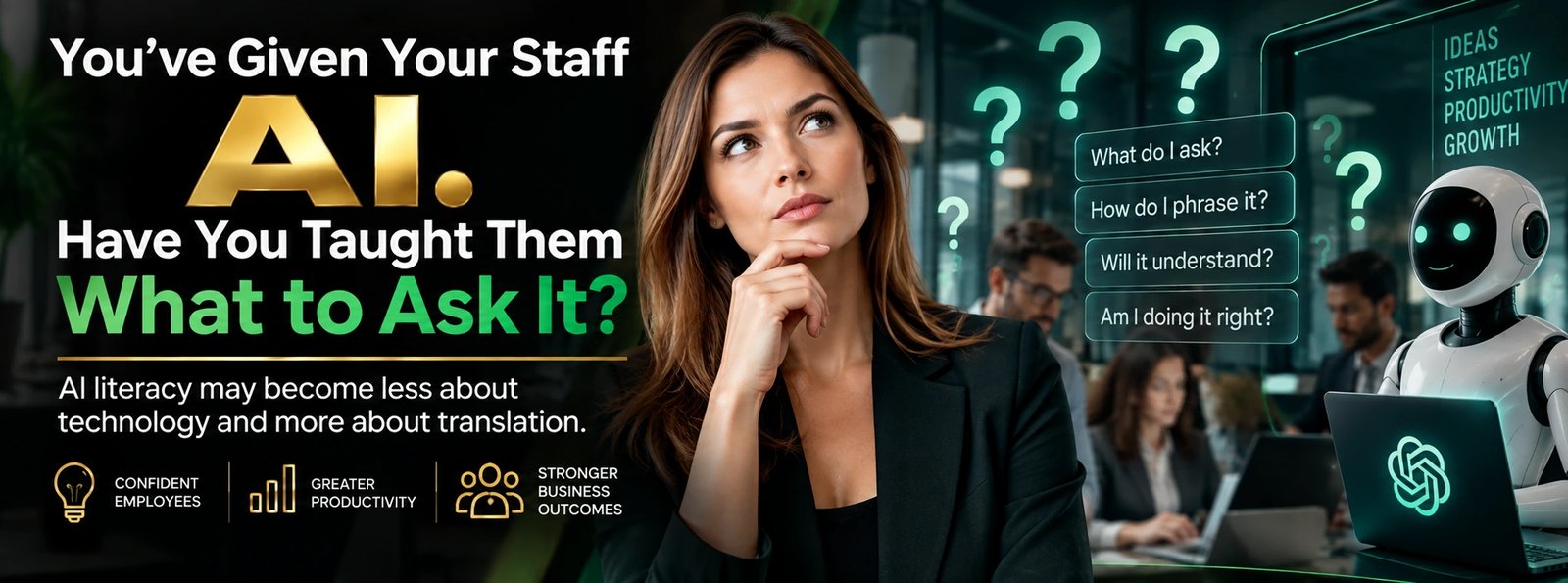
*AI literacy may become less about technology and more about translation.*
For the past few years, the corporate conversation around artificial intelligence has focused heavily on access.
- Which AI platform should we use?
- Should employees have access to ChatGPT?
- Should we introduce Microsoft Copilot?
- What are our security policies?
- What can employees upload?
- Who should be allowed to use generative AI?
All important questions.
But I believe another problem is quietly becoming much more significant.
Employees have access to AI — but many still don't know what to ask it.
And that could become one of the biggest barriers to meaningful AI adoption inside organisations.
Access is not the same as adoption
Giving somebody access to generative AI does not automatically make that person productive with it.
An employee can open ChatGPT, Claude, Gemini or another generative AI tool and still be faced with a completely empty box.
The technology is waiting. The employee is thinking:
> "What exactly am I supposed to type?"
Or they type something vague. They receive a disappointing response. They conclude that AI isn't particularly useful for their job.
Another employee writes an enormous instruction containing several paragraphs because they believe sophisticated AI requires sophisticated prompts. Ten minutes later, they've almost spent as much time constructing the prompt as they might have spent doing the task.
Neither scenario represents successful AI adoption.
The organisation has deployed the technology. But it hasn't necessarily enabled the workforce.
The missing layer may be surprisingly simple
I describe it as an AI Workforce Enablement Platform.
Underneath that rather corporate-sounding phrase is a very straightforward idea:
> A searchable task layer that helps employees know what to ask generative AI.
An employee shouldn't necessarily need to understand prompt engineering. They shouldn't need to remember complicated prompt frameworks. And they certainly shouldn't have to become an AI specialist simply to use AI effectively in their everyday role.
They should be able to think:
- "I need to follow up with a customer."
- "I need to analyse this spreadsheet."
- "I need to turn these notes into a report."
- "I need interview questions."
- "I need to respond to this complaint."
- "I need to promote this product."
Then find the appropriate task, give AI the necessary context and get to work.
That seemingly small change moves AI from being a technology employees are expected to understand to a tool employees can actually use.
PPG offers an interesting example
PPG is a global organisation operating in more than 50 countries, with $15.9 billion in 2025 net sales. Its leadership includes Bhaskar Ramachandran, Vice President, Information Technology and Chief Information Officer, and Robert Massy, Senior Vice President and Chief Human Resources Officer.
PPG has also been very public about its digital ambitions.
In its 2025 reporting, the company described digital transformation as an important enabler of operational efficiency and improved customer experience. It highlighted increased use of AI within manufacturing and product development and said its teams are using digital technologies to shorten development cycles, reduce waste and improve productivity.
PPG has also explicitly identified artificial intelligence as an employee-related issue, saying responsible AI use involves enabling people to make use of the best tools available while safeguarding sensitive data and intellectual property.
The other challenge is in training. Training thousands of employees to use AI presents a practical problem of its own. Large organisations must account for trainers, scheduling, multiple locations, different departments, staff availability and the cost of taking employees away from their normal work. By the time a company has designed and delivered a large-scale AI training programme, parts of that training may already be outdated because generative AI is evolving so quickly.
This is why organisations may need more than traditional training. What if every employee, regardless of department or seniority, had access to a simple, scalable tool that helped them communicate with AI in real time? A silent workforce companion that translates everyday tasks into clear, precise AI instructions. Instead of remembering complex prompting techniques, employees could search for what they need to do, select a short command and get to work.
The training becomes less about memorising prompts and more about using AI confidently, safely and productively.
This is where technology strategy and people strategy increasingly collide.
The CIO can provide the technology. The HR and learning teams can encourage adoption. The organisation can develop responsible-use policies.
But there is still one very human question sitting between the employee and the AI:
> What should I ask it to do?
This is the AI adoption gap
Businesses have spent enormous amounts of time discussing AI capability. I think we now need to spend more time discussing AI usability at workforce level.
There is a difference between asking:
*"How many employees have access to generative AI?"*
and asking:
*"How many of those employees can confidently identify a work task and instruct AI to help them complete it?"*
Those are completely different measures of AI readiness.
A company could theoretically have 10,000 AI-enabled employees while only a fraction of them use the technology meaningfully every week.
That isn't an access problem. It's an enablement problem.
Prompt engineering cannot be the answer for everybody
Prompt engineering is valuable.
But expecting every receptionist, salesperson, administrator, manager, lecturer, customer-service representative, HR officer and operations employee to become a prompt engineer is unrealistic.
Most people don't want to study prompting. They want to get their work done.
This is exactly what led me to develop AI Prompt Shortcuts.
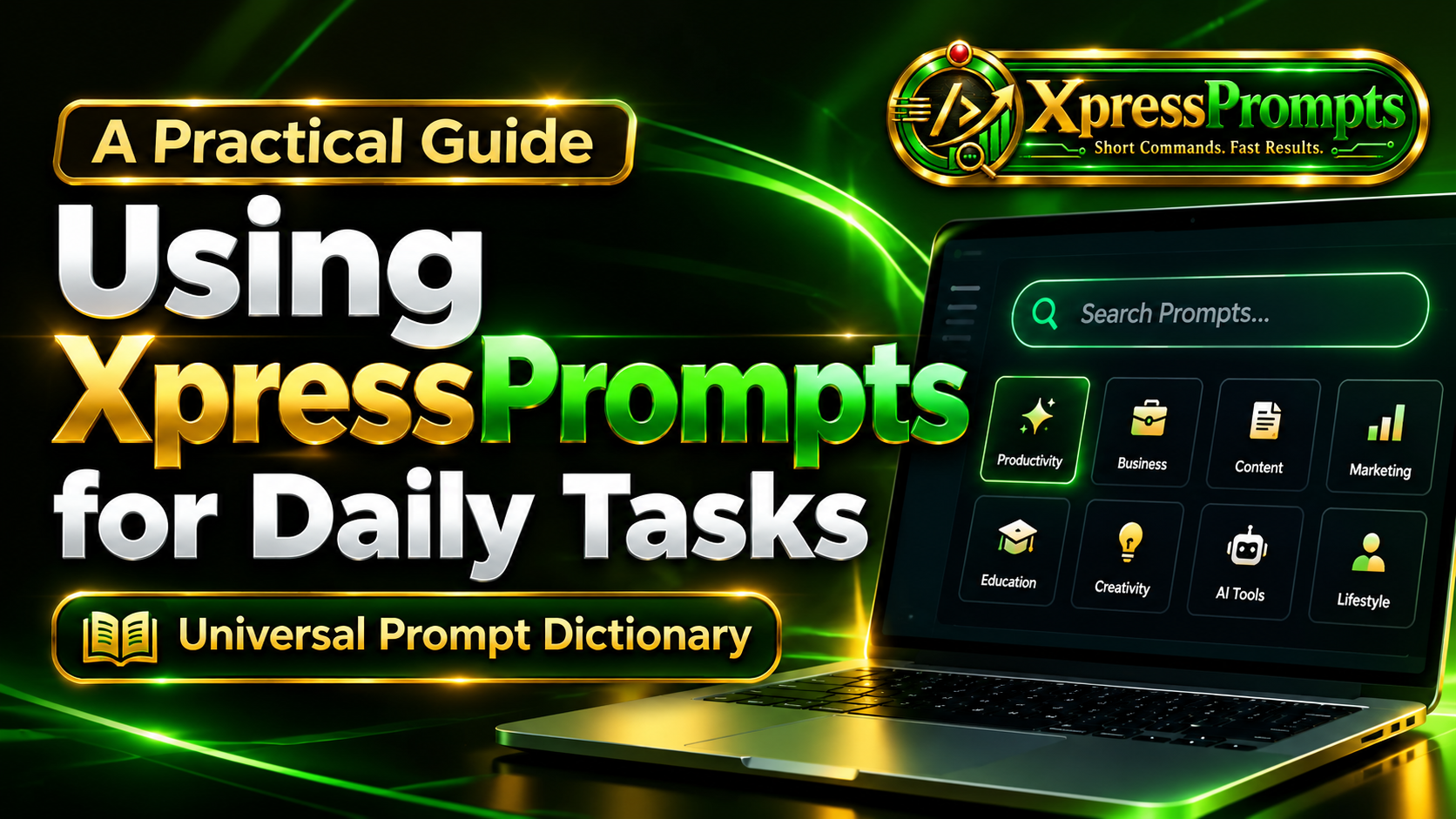
Instead of asking users to construct increasingly complicated prompts, the platform starts with the job they want AI to perform.
1. Search for the task.
2. Choose the appropriate shortcut.
3. Add the relevant information, document, image or context.
4. Then work with the AI.
The shortcut isn't intended to replace human thinking. It removes the unnecessary friction between:
*"I know what I need to get done"*
and
*"I know how to explain that task to AI."*
That distinction matters.
AI literacy may become less about technology and more about translation
We often talk about AI literacy as understanding artificial intelligence.
Perhaps part of AI literacy will actually be the ability to translate human intention into machine instruction.
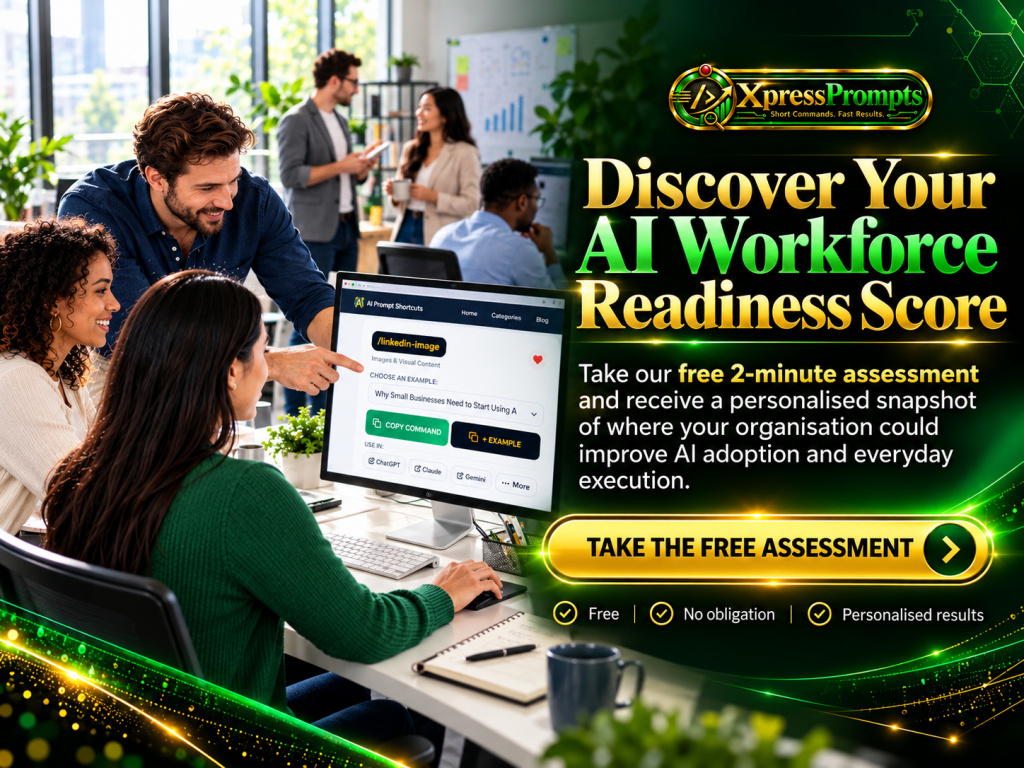
Click here to take the assessment https://www.qualiquiz.app/quiz/discover-your-ai-workforce-readiness-assessment-report
Employees already know their jobs.
- The salesperson understands the customer.
- The HR manager understands recruitment.
- The marketing executive understands the campaign.
- The operations manager understands the process.
The problem is often not their professional knowledge. It's translating:
*"This is what I need"*
into:
*"This is what I need AI to do."*
That translation layer is where I believe a significant new category of workplace technology will emerge.
The question leaders should now be asking
When organisations review their AI strategy, I think the conversation needs to move beyond licences and approved platforms.
Leadership teams should begin asking:
- Do our employees know which everyday tasks AI can help them perform?
- Can employees instruct AI confidently without needing specialist knowledge?
- Are we measuring actual AI usage rather than simply AI availability?
- Are different departments being shown practical use cases relevant to their own work?
- What happens after we tell somebody, "You can use ChatGPT"?
That last question may prove surprisingly important.
Because the blank prompt box remains one of the simplest — and most underestimated — barriers to widespread AI adoption.
The next phase of enterprise AI won't just be deployment
It will be enablement.
The organisations that benefit most from generative AI may not necessarily be those that purchase the most sophisticated technology. They may be the organisations that make that technology easiest for ordinary employees to use.
That means moving from:
*"Here is an AI tool."*
to:
*"Here is how AI can help you with the work you already do."*
And perhaps the most important question for CEOs, CIOs and HR leaders isn't:
*"Have we given our employees AI?"*
It is:
"Have we taught them what to ask it?"
Because the problem is no longer simply access to AI. The problem is knowing what to ask.
And solving that problem could determine whether enterprise AI becomes another piece of underused software — or one of the biggest productivity shifts in the modern workplace.
You've invested in AI. Now make sure your workforce can use it.
Many organisations have already given employees access to generative AI. The challenge is no longer access — it is adoption.
AI Prompt Shortcuts is a scalable workforce enablement platform designed to help employees communicate with AI more effectively, without requiring everyone to become a prompt engineer.
Through a searchable library of precise, task-based commands, employees across marketing, sales, HR, administration, customer service, research and management can quickly identify what they need AI to do and communicate that requirement in shorthand.
The result is a simpler route from business task to AI execution — reducing hesitation, shortening instructions and helping organisations move from AI availability to practical everyday use.
For leadership teams, the question is becoming:
Have you given your employees AI — or have you enabled them to use it?
Explore AI Prompt Shortcuts — or contact us about enterprise access for your whole team.
#AITransformation #FutureOfWork #EnterpriseAI #AIProductivity #DigitalTransformation #WorkforceEnablement