The 5 Stages of AI Adoption: Why Your Workforce Isn’t Moving at the Same Speed
2026-11-21
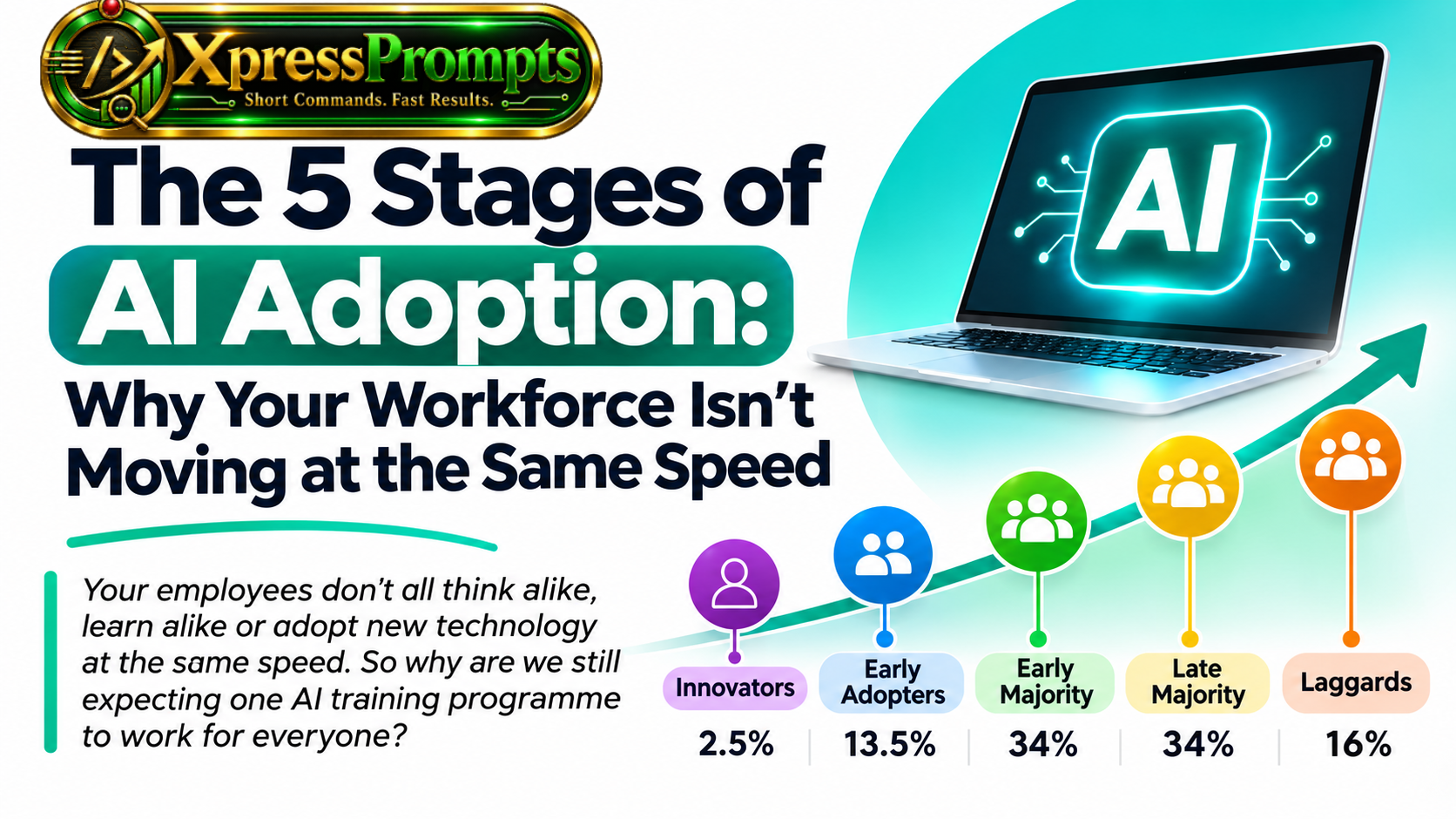
Your employees don’t all think alike, learn alike or adopt new technology at the same speed. So why are we still expecting one AI training programme to work for everyone?
You’ve Introduced AI. But Has Your Workforce Actually been given the tools to Adopt It without becoming prompt engineers?
Imagine an organisation with 500 employees.
Management announces that everyone now has access to an artificial intelligence tool such as ChatGPT, Claude or Gemini.
The organisation arranges training sessions, sends out instructions and encourages employees to experiment.
Within a few weeks, something interesting happens.
Some employees are already using AI to develop new ideas, organise information and support everyday tasks.
Others are experimenting but remain unsure how to get useful results.
A large group is waiting to see whether AI is genuinely worth the effort.
Some are concerned about making mistakes, protecting information or disrupting established processes.
And others simply cannot see why they should change the way they’ve been working successfully for years.
Same organisation. Same technology. Five very different responses.
Is the problem that employees are resisting change?
Or have we failed to recognise that successful technology adoption depends on understanding how different people approach something new?
This is where a theory developed more than 60 years ago becomes particularly relevant to today’s AI revolution.
It’s called the Technology Adoption Curve.
And I believe it offers an important lesson for every organisation investing in AI.
Giving employees access to AI is not the same as enabling them to use it effectively.
What Is the Technology Adoption Curve?
The Technology Adoption Curve originates from the Diffusion of Innovations theory introduced by American sociologist Everett Rogers in 1962.
Rogers studied how new ideas, products and technologies spread through communities.
He proposed that people adopt innovations at different stages, influenced by factors including perceived usefulness, compatibility with existing practices, complexity, opportunity to experiment and evidence of results.
His model identified five broad categories of adopters:
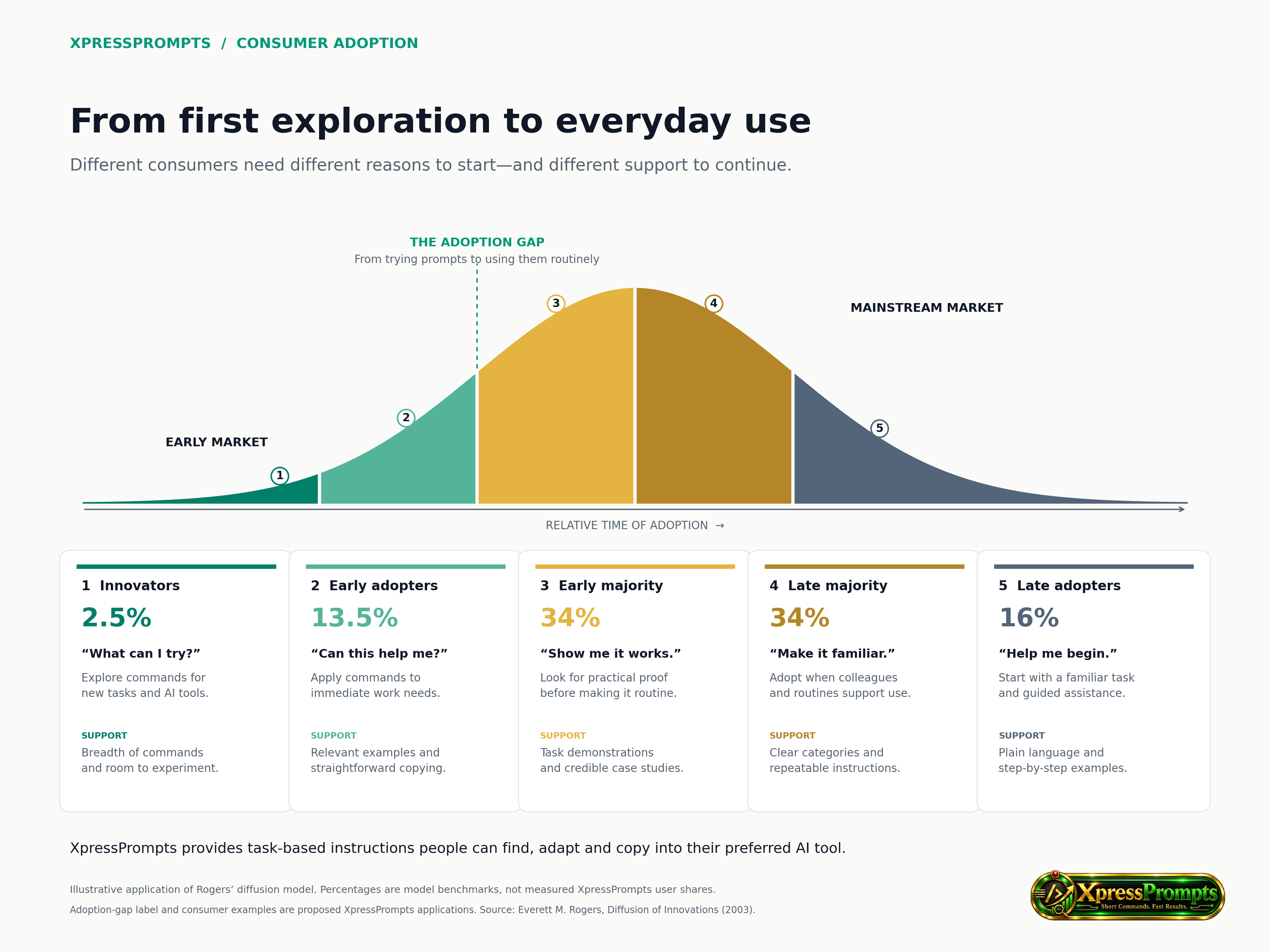
These percentages describe a theoretical distribution based on relative timing of adoption. They are not a prediction that every company will have exactly this proportion of employees in each category.
But the model provides an important insight.
People do not automatically embrace something new simply because it becomes available.
They need different combinations of confidence, evidence, motivation and practical support.
For organisations introducing artificial intelligence, understanding these differences could change how they approach workforce development.
Stage 1: Innovators (2.5%) — The Employees Already Experimenting With AI
Every workplace has people who are naturally curious about new technology.
These are the employees who don’t necessarily wait for management to announce an AI initiative.
They’ve already explored ChatGPT.
They’ve experimented with generating content, summarising information or automating parts of their work.
Some may even be testing AI applications that haven’t yet been formally introduced within their organisation.
What motivates innovators?
Innovators are often motivated by curiosity, experimentation and discovery.
They enjoy understanding what new tools can do.
They are willing to explore unfamiliar features, test ideas and learn through trial and error.
They may see potential applications long before their colleagues recognise them.
The challenge for organisations
Innovators can be valuable contributors to AI adoption, but enthusiasm alone doesn’t guarantee safe or effective practice.
An employee who experiments independently may overlook organisational policies, confidentiality requirements or the limitations of AI-generated information.
Equally, innovators may become frustrated when the rest of the organisation is slow to embrace technology they already understand.
How XpressPrompts can support innovators
Innovators don’t necessarily need basic explanations of what ChatGPT is.
They need opportunities to explore useful applications.
XpressPrompts can help them discover task-specific prompt commands across different work activities.
Rather than repeatedly developing instructions from scratch, they can find a relevant command, adapt it to their needs and test it with their preferred approved AI assistant.
They can also help identify which tasks and commands are genuinely useful to their colleagues.
The opportunity: Encourage innovators to become responsible AI champions who share practical examples, rather than treating them as the standard everyone else must immediately reach.
Stage 2: Early Adopters (13.5%) — The Employees Who Recognise AI’s Potential
Early adopters are usually interested in innovation but may take a more considered approach than innovators.
They want to see how technology can improve outcomes.
In the workplace, these are often employees who recognise the possible benefits of AI and are prepared to lead by example.
They might be a department manager looking to improve administrative efficiency.
An HR professional exploring how AI could support recruitment documentation.
A marketing employee seeking more effective ways to develop campaign content.
Or a teacher interested in preparing learning resources.
What motivates early adopters?
Early adopters tend to respond to opportunities that have clear potential.
They’re willing to try something new when they understand its relevance.
They can also influence colleagues because their opinions are trusted.
This makes them particularly important in organisational change.
The challenge for organisations
An enthusiastic early adopter may discover several valuable uses for AI.
But their success doesn’t automatically mean everyone else will follow.
Other employees might think:
That’s fine for someone who understands technology. But how would I use it?
This is where many workplace AI initiatives begin to lose momentum.
The people who were already interested become increasingly capable, while less confident employees remain observers.
How XpressPrompts can support early adopters
XpressPrompts offers a way for early adopters to demonstrate practical AI use without expecting colleagues to reproduce complicated instructions.
For example, a manager preparing meeting documentation could find the `/meeting-minutes` command.
A marketing colleague could explore `/facebook-ad`.
A customer relations employee could use `/customer-reactivation` as a starting point for drafting appropriate customer communications.
These are examples of searchable task-based prompt commands, not official built-in commands in ChatGPT or other AI tools.
Each command provides a starting point that can be adapted to a specific task.
The result is generated by the chosen AI assistant and must still be reviewed.
The opportunity: Turn early adopters into relatable examples of how AI can support everyday work.
Employees are often more interested in seeing a colleague complete a familiar task than watching another presentation about AI’s capabilities.
Stage 3: Early Majority (34%) — The Employees Who Need Evidence Before They Engage
This is where organisational AI adoption becomes particularly interesting.
The early majority is a much larger group than the innovators and early adopters combined.
These employees are not necessarily opposed to change.
They are practical.
They want to know whether a new technology actually works, whether it is reliable and whether learning to use it is worth their time.
They may have watched colleagues experimenting with ChatGPT without feeling compelled to participate.
Their questions are reasonable:
Will it genuinely help me?
How much additional work will I have to do to learn it?
What if the answer is wrong?
Will it work for the tasks I handle every day?
What motivates the early majority?
Evidence, relevance and reliability.
They want practical examples involving work they recognise.
They don’t necessarily want to become AI experts.
They want to understand how AI can help them complete their responsibilities more effectively.
The challenge for organisations
Many AI training programmes concentrate on demonstrating what the technology can do.
But the early majority needs something different.
They need to experience how it works in their own roles.
Consider an employee who spends several hours each week preparing customer correspondence.
A detailed lecture on prompt engineering may not immediately address their problem.
A demonstration showing how to turn rough notes into a professional draft, followed by an opportunity to practise, could be far more meaningful.
How XpressPrompts can support the early majority
This is one of the problems XpressPrompts is designed to address.
Instead of expecting employees to remember complicated prompting techniques, they can search for the task they want to accomplish.
They choose a suitable short-command prompt, add relevant details and use it with their approved AI tool.
They can then check and refine the result.
The value is in reducing the difficulty of getting started.
The opportunity: Make AI adoption about completing familiar tasks, not mastering unfamiliar technology.
For this group, a practical example may be more persuasive than an ambitious presentation about digital transformation.
The AI Adoption Chasm: Where Many Organisations Lose Momentum
There is another important concept that deserves attention.
In his 1991 book Crossing the Chasm, Geoffrey Moore developed the idea that a significant gap can exist between enthusiastic early adopters and the more cautious early majority.
Although originally developed in the context of marketing new technology products, the concept offers a useful way to think about workplace AI adoption.
Early adopters are often attracted by possibilities.
The early majority wants practical evidence.
An organisation might have enthusiastic employees, impressive demonstrations and successful experiments.
But unless those experiences can be translated into reliable, accessible ways for other staff to work, adoption may struggle to spread.
The workplace AI chasm
Imagine a company where 30 employees regularly use AI and are enthusiastic about it.
Management celebrates the success.
But another 200 employees rarely use the tools.
Why?
Perhaps they don’t know what to ask.
Perhaps the training was too technical.
Perhaps nobody has demonstrated how AI relates to their work.
Perhaps they worry about generating incorrect information.
Or perhaps their existing workload simply leaves no room for experimentation.
The organisation has successfully introduced AI to its enthusiastic employees.
But it has not necessarily created the conditions for wider adoption.
The gap is not always between people who like technology and people who don’t. Sometimes it’s between people who know what to do with AI and people who haven’t been shown a practical starting point.
This distinction matters enormously.
To move beyond a small group of enthusiasts, organisations need to make AI useful, understandable and trustworthy for employees who aren’t naturally interested in experimenting.
That’s where task-based support becomes especially valuable.
Stage 4: Late Majority (34%) — The Employees Who Need Reassurance and Simplicity
The late majority is another substantial group.
These employees may be cautious about unfamiliar technology and prefer established ways of working.
They may not see an immediate reason to change.
Some may have experienced previous digital initiatives that promised improvements but delivered more complications.
Others may be concerned about their ability to learn new systems.
What motivates the late majority?
Practical necessity, confidence and reassurance.
They want to know that the technology is established enough to be dependable.
They want help when something goes wrong.
And they often want clear instructions without unnecessary complexity.
For these employees, another intensive training course may reinforce the feeling that AI is difficult.
The challenge for organisations
When organisations treat reluctance as resistance, they risk creating an unnecessary divide.
An employee who is uncertain about AI may still be exceptionally skilled at their job.
They may understand customers, procedures and operational challenges better than someone with advanced technical knowledge.
The problem isn’t necessarily a lack of ability.
It may simply be that the technology has not yet been presented in a way that connects with their experience.
How XpressPrompts can support the late majority
XpressPrompts offers a straightforward approach based on the work people already understand.
Instead of asking employees to invent detailed prompts, they can search for relevant instructions.
They don’t need to memorise hundreds of commands.
They don’t need to start with an empty AI chat box.
They can begin with a familiar task and receive practical assistance with explaining that task to AI.
For example, an experienced administrator who has spent years preparing business letters may understand exactly what a professional letter should contain.
What they may not know is how to instruct AI to produce a suitable draft.
That is the gap XpressPrompts aims to help bridge.
The opportunity: Build confidence through small, manageable successes supported by clear guidance and human assistance.
The employee’s existing knowledge remains valuable. AI becomes another tool they can use.
Stage 5: Laggards (16%) — The Employees Who May Have Good Reasons to Wait
The final group in Rogers’ original model is described as laggards.
I think we need to be particularly careful with this terminology when applying the theory to employees.
In a workplace, labelling someone a laggard can sound insulting.
It can create the impression that people who adopt technology slowly are somehow less capable, less motivated or less valuable.
That is not a constructive way to support workforce development.
I prefer to think of this group as employees who are highly cautious, unconvinced or facing significant barriers to adoption.
Why might employees avoid AI?
There can be many reasons.
Some may have limited experience with digital tools.
Others may be concerned about confidentiality, employment security or the accuracy of AI-generated information.
Some may have accessibility needs that existing training has not accommodated.
Others may work in environments where AI provides little immediate value or where its use raises legitimate professional and regulatory concerns.
And some simply prefer to continue using methods they know and trust.
These concerns deserve to be heard.
The challenge for organisations
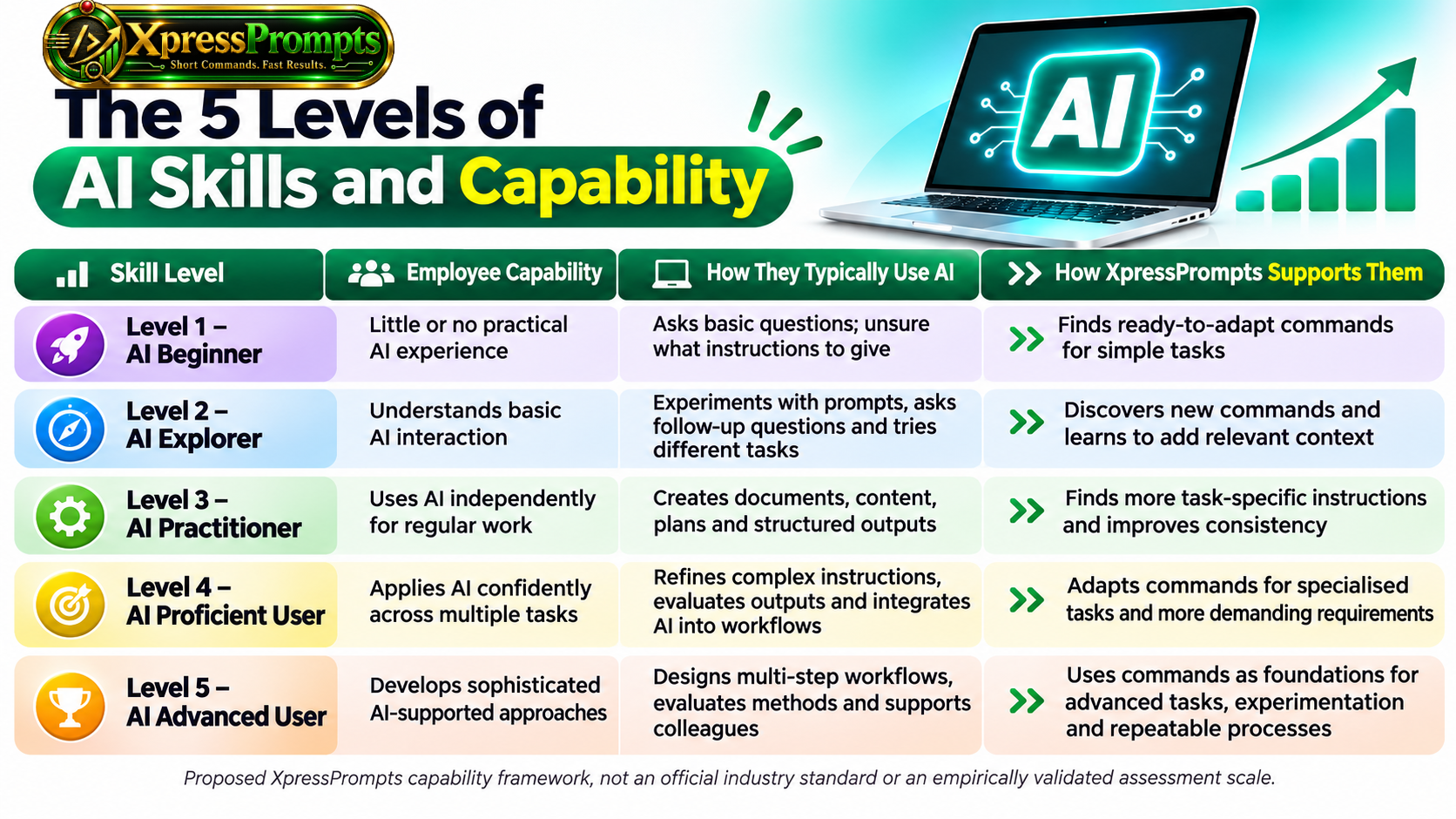
Forcing technology adoption without understanding people’s concerns can create resentment and distrust.
A better approach begins with listening.
Ask employees what worries them.
Find out whether their concerns relate to time, training, safety, accuracy or practical usefulness.
Identify whether AI is actually appropriate for their responsibilities.
Then provide proportionate support.
How XpressPrompts can support cautious employees
Where AI is appropriate, XpressPrompts can provide a less intimidating starting point.
An employee can begin with a low-risk, familiar task.
They can explore a short-command prompt with support from a colleague.
They can see what the AI produces, review it and decide whether the result is useful.
There is no requirement to become an advanced AI user overnight.
The opportunity: Replace pressure with reassurance, practical assistance and respect for existing experience.
Sometimes the best introduction to AI isn’t a course.
It’s someone sitting alongside you and helping you complete one familiar task.
Conclusion
XpressPrompts is not designed exclusively for beginners or employees who lack confidence with artificial intelligence. It is a searchable, task-based command dictionary developed to support people at every stage of the technology adoption curve.
The same dictionary serves employees with considerably more AI experience.
Innovators can discover new applications, explore different approaches and experiment with more advanced tasks.
Early adopters can use the dictionary to develop practical applications, improve their instructions and demonstrate relevant uses of AI to colleagues.
The early majority can find established, task-focused starting points that help them incorporate AI into everyday responsibilities.
The late majority can access straightforward instructions that reduce complexity and make AI easier to introduce into familiar working practices.
Highly cautious or first-time users can begin with manageable tasks, supported by clear instructions and appropriate guidance.
This is an important distinction.
XpressPrompts does not categorise or restrict users according to their level of AI experience. It gives them access to the same growing dictionary of short commands, which they can use according to their own knowledge, confidence, responsibilities and objectives.
A first-time user might search for help drafting a professional email.
An experienced manager might use the dictionary to help structure a strategic review, analyse a business process or develop a departmental improvement plan.
Both are using the same resource, but applying it at different levels of complexity.
The dictionary is designed to remain useful as an individual’s AI capabilities develop, rather than becoming redundant once they gain confidence.
The opportunity: Give every employee access to a practical AI command resource that supports their immediate needs while enabling them to explore more complex applications as their experience grows.
The objective is not simply to help people start using AI.
It is to support continuous AI capability development across the entire workforce.
“One dictionary. Five stages of adoption. Different levels of experience. A practical command resource that grows with your workforce’s capabilities.”
What the Latest UK Research Tells Us About AI Workforce Adoption
The relevance of practical AI learning is becoming increasingly difficult to ignore.
In 2026, the UK government’s Skills for Artificial Intelligence programme published research examining what works when organisations develop employees’ AI skills.
The research drew upon 23 workshops involving around 150 organisations, 10 case studies and a UK employer survey with 536 responses.
One finding deserves particular attention.
AI use is increasing faster than workforce capability.
The research identified limited time, pressure on employees and training that isn’t sufficiently connected to real work as important barriers.
Developing the PRIMES framework for more effective AI training for your workforce
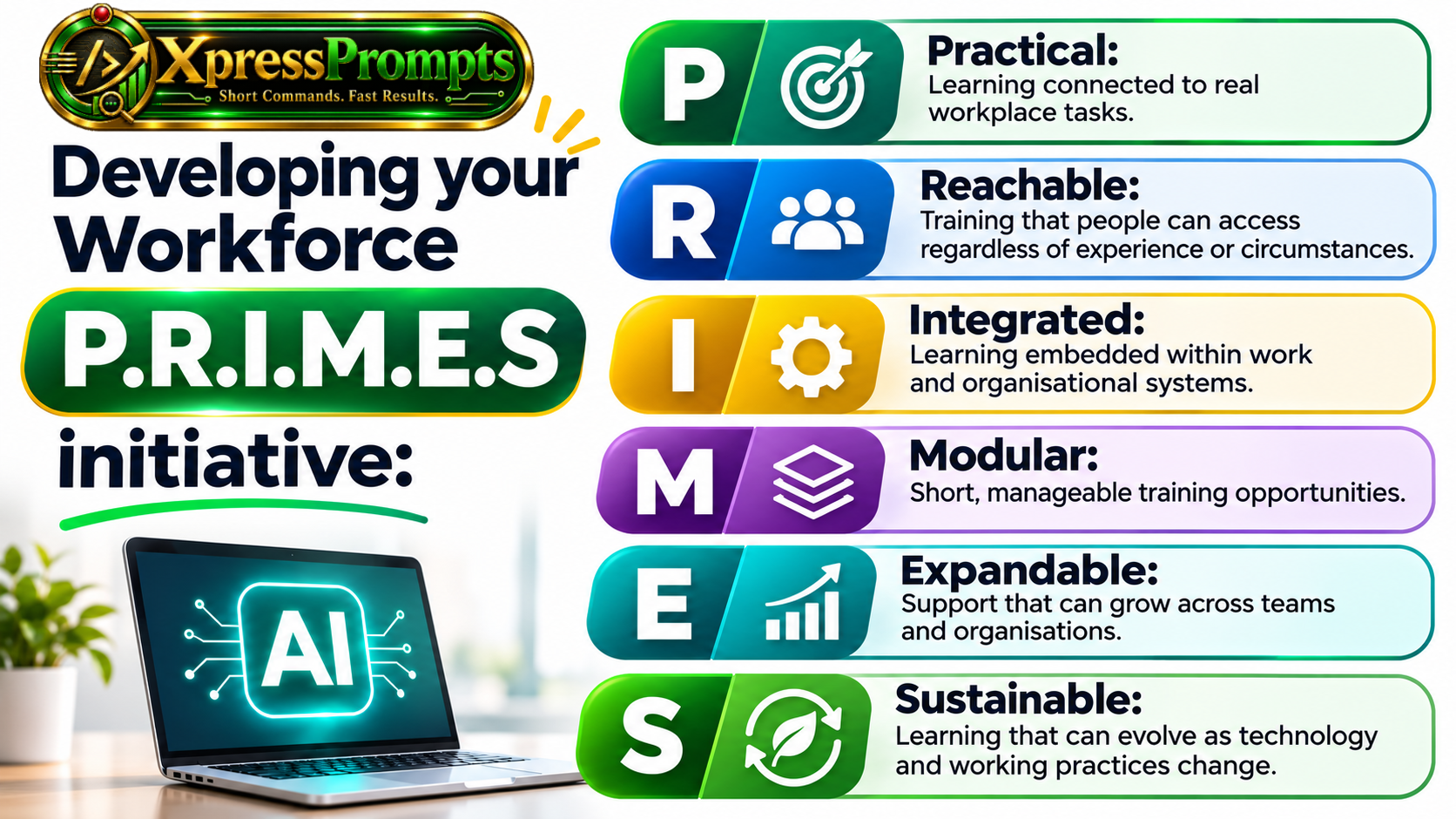
PRIMES stands for:
- Practical: Learning connected to real workplace tasks.
- Reachable: Training that people can access regardless of experience or circumstances.
- Integrated: Learning embedded within work and organisational systems.
- Modular: Short, manageable training opportunities.
- Expandable: Support that can grow across teams and organisations.
- Sustainable: Learning that can evolve as technology and working practices change.
These principles provide a useful foundation for organisations rethinking how they introduce AI.
They also reinforce the importance of providing practical support at the point where employees need it.
XpressPrompts is designed around a related principle: helping people access useful AI instructions for the work they are doing.
It is not a replacement for approved AI tools, workplace governance or responsible-use training.
It is a practical layer that can support employees in moving from understanding that AI exists to knowing what to ask it to do.
One Organisation. Five Different Starting Points. Why Are We Still Offering One Training Experience?
This is the question I believe HR departments, learning and development teams and enterprise leaders should be asking.
If we know employees approach innovation differently, why do we so often expect everyone to learn through the same programme?
Consider the following example.
A company introduces generative AI across its customer service, HR, finance, marketing and operations departments.
It provides identical training to everyone.
The content explains prompting frameworks, explores general examples and demonstrates the technology’s capabilities.
But the employees have very different responsibilities.
A customer service employee needs assistance organising customer communications.
An HR employee might need help drafting internal announcements.
A marketing employee wants to develop campaign ideas.
A finance employee may need to structure a report, while observing strict confidentiality requirements.
An operations manager wants to organise meeting notes and identify follow-up actions.
They don’t necessarily need the same starting exercises.
Different departments. Different tasks. One searchable command layer.
That is one of the central ideas behind XpressPrompts.
Instead of assuming that every member of staff must learn a large collection of prompts, the organisation can make task-relevant instructions available when employees need them.
The work provides the context.
The command provides the starting point.
The AI assistant produces the draft or response.
And the employee applies their professional judgement.
This makes it possible to combine consistent access to practical prompting support with the flexibility different departments require.
How XpressPrompts Can Support All Five Stages of AI Adoption
XpressPrompts is a searchable online dictionary of short-command prompts that help people develop clearer instructions for AI tools such as ChatGPT, Claude and Gemini.
It is designed to address a common problem:
Employees may have access to AI but remain uncertain what to ask it to do.
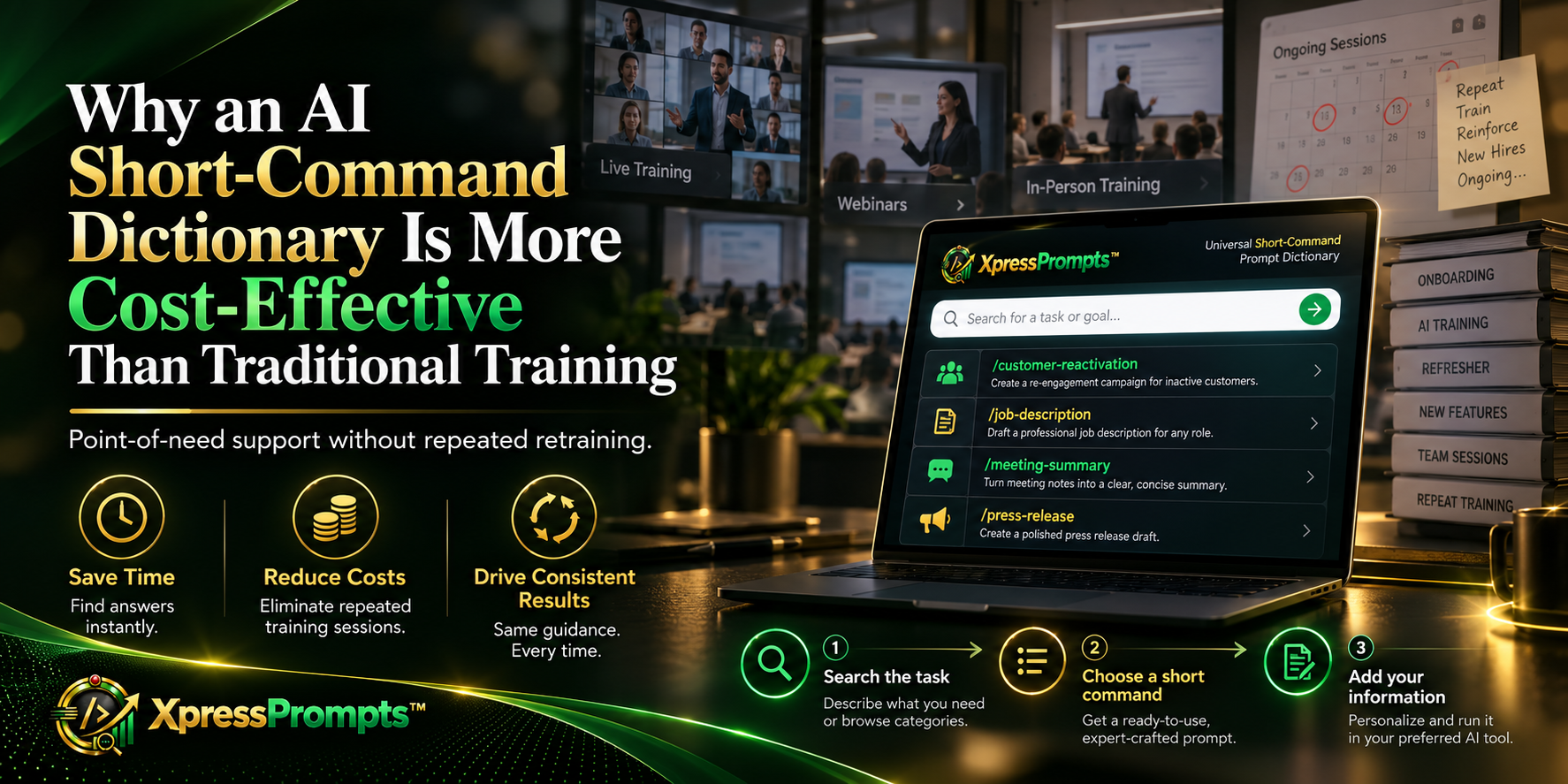
Rather than creating each instruction from scratch, they can search for a task, choose a relevant prompt command, add information about their needs and use that instruction with an AI assistant.
Here is how this approach can support employees at different stages.
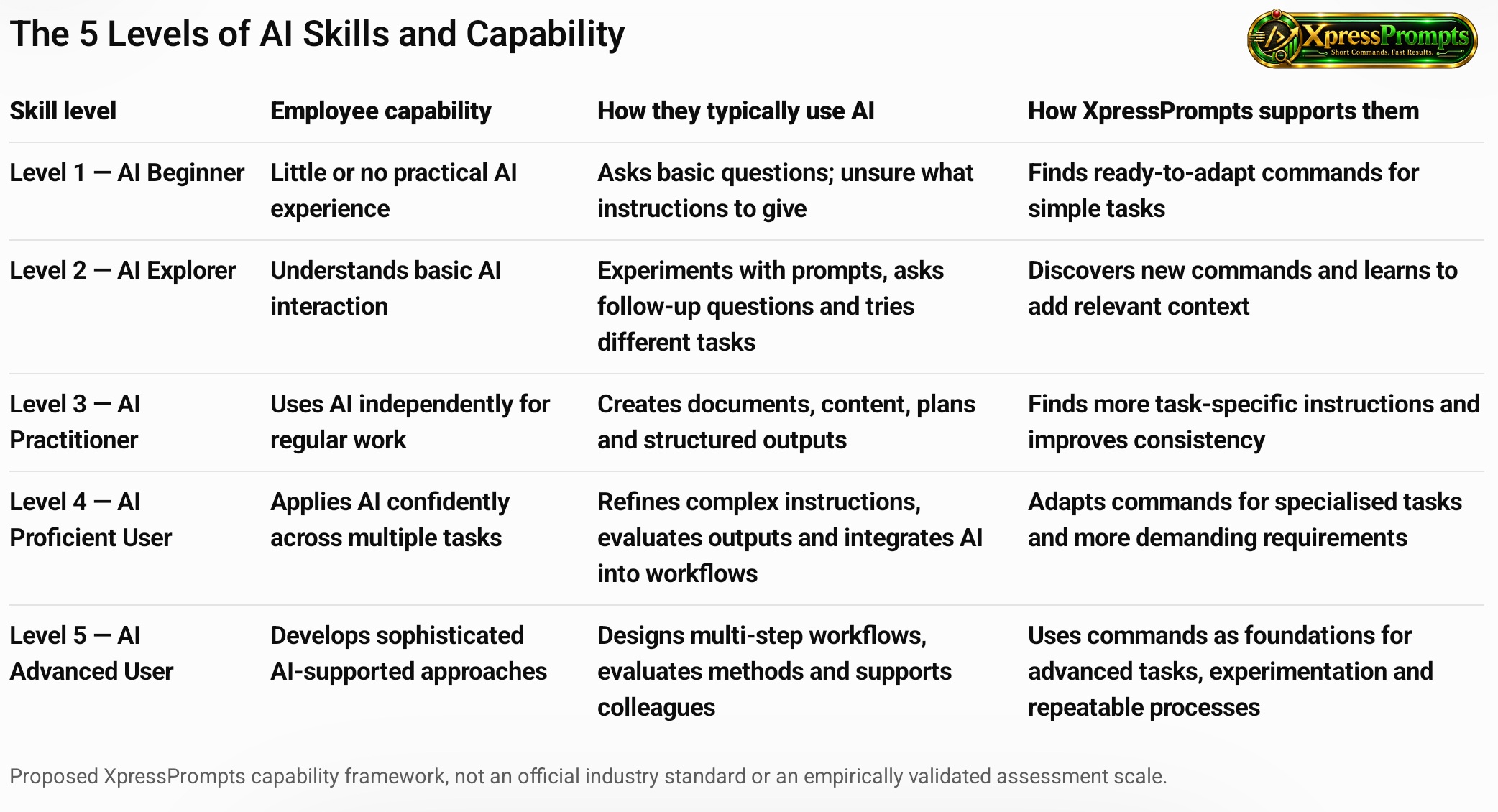
The value is not that everyone suddenly becomes equally confident.
The value is that employees can access support suited to the task they are attempting, without having to memorise complicated prompt structures.
Importantly, XpressPrompts doesn’t generate the finished work itself. It helps create the instruction that employees take to their chosen AI tool.
That distinction matters.
The objective is to make prompt development easier so that people can concentrate on their work and assess the results.
A Practical 30-Day Pilot to AI Workforce Enablement
Organisations don’t need to transform every employee’s working practices at once.
A measured approach can help leaders understand what employees need, identify useful applications and assess whether adoption is improving.
Here is a suggested 30-day structure.
Week 1: Understand Your Workforce
Before introducing another AI training initiative, establish your starting point.
Ask employees:
- Have you used an approved AI tool at work?
- Do you feel confident knowing what to ask?
- Which everyday tasks might benefit from AI assistance?
- What concerns do you have about using AI?
- What kind of practical support would help?
Use the results to understand differences in confidence, experience and operational requirements.
Importantly, don’t assign people permanent labels based on the adoption curve.
Someone may be an enthusiastic adopter of AI writing assistance but cautious about using AI in financial decisions.
That distinction is entirely reasonable.
Week 2: Introduce Practical Tasks
Select a small number of appropriate tasks across participating departments.
Provide the relevant AI policies, privacy safeguards and basic training before staff begin.
Make it easy for employees to find task-relevant instructions through XpressPrompts.
Start with familiar, low-risk activities where staff can easily check the AI-generated result.
Encourage participants to add their own context, review outputs and improve instructions where necessary.
Week 3: Encourage Learning by Doing
Support employees as they apply AI to real work.
Invite early adopters to demonstrate useful examples without pressuring their colleagues.
Give less confident employees access to individual support.
Ask participants to record which tasks they attempted, what worked, where they struggled and whether the results were helpful.
The objective is not to maximise the number of AI interactions.
It is to develop useful, responsible working practices.
Week 4: Evaluate What Has Changed
At the end of the initial period, assess whether the initiative has helped.
Useful measures could include:
- Number of employees who successfully complete a first supported AI task.
- Percentage of participants returning to use AI again.
- Employee confidence before and after practical participation.
- Reported time spent on selected tasks.
- Quality and usefulness of reviewed AI outputs.
- Barriers that remain unresolved.
These are suggested evaluation measures, not guaranteed results from using XpressPrompts.
The findings can help organisations decide what support to expand, improve or reconsider.
A short pilot can reveal more about real workforce needs than assuming that a completed training session automatically means employees are ready.
We Need to Stop Confusing AI Training With AI Capability
There is an important difference between teaching someone about AI and helping them become capable of using it.
An organisation can deliver extensive AI training.
Employees can attend presentations.
They can receive certificates.
They can understand the terminology.
But when they return to their desks, some may still be staring at an empty ChatGPT window wondering what to type.
That should tell us something.
Training completed does not necessarily mean capability developed.
Real capability involves knowing when AI is appropriate, communicating a task effectively, recognising limitations, evaluating the result and applying professional judgement.
It develops through a combination of guidance, practice, experience and feedback.
And those activities should be connected to the work people already understand.
This is especially important for experienced employees.
A person with 20 years of knowledge in customer service, education, administration or operations shouldn’t need to start from zero simply because a new technology has arrived.
They already understand their work.
What they may need is help communicating their expertise and requirements to an AI assistant.
That is a far more practical starting point for workforce development.
The Technology Adoption Curve Is Useful — But People Are More Complex Than Five Categories
There is one final consideration.
Rogers’ model is influential, but it should not be treated as a rigid formula for classifying employees.
Adoption is affected by far more than individual attitudes.
Access to technology, organisational culture, management support, accessibility, workload, trust, governance and the usefulness of a particular application all influence outcomes.
The same person may embrace one innovation while rejecting another.
And sometimes choosing not to adopt a technology is the correct decision.
For example, employees dealing with sensitive information may have legitimate concerns about using an unapproved AI system.
Their caution shouldn’t be interpreted as an unwillingness to learn.
This is why responsible AI adoption requires good organisational judgement alongside practical enablement.
The technology adoption curve helps us ask better questions.
It should never become a tool for making unfair assumptions about employees.
The Future of AI Adoption Is Not About Making Everyone a Technology Enthusiast
I believe we are approaching a crucial stage in how organisations think about AI.
For years, the conversation has concentrated on the technology itself.
Which AI platform should we purchase?
Which model is the most advanced?
How much can we automate?
What training should employees complete?
These are important questions.
But there’s another question that deserves more attention.
How do we help people with different levels of confidence, knowledge and experience benefit from AI without making their working lives more complicated?
That should be at the centre of workforce enablement.
We don’t need every employee to become an AI innovator.
We don’t need everyone to understand advanced prompt engineering.
And we certainly shouldn’t assume that a person who adopts AI slowly has less to contribute.
What we need is a practical, inclusive approach that respects people’s existing abilities and gives them appropriate support.
Innovators need opportunities to explore.
Early adopters need meaningful applications.
The early majority needs evidence that AI is useful.
The late majority needs simplicity and reassurance.
And highly cautious employees need their concerns heard and their circumstances understood.
Different people. Different starting points. Different tasks. One shared opportunity to develop capability.
The success of AI should not be measured simply by how many employees have access to it.
It should be measured by how responsibly and effectively people can use it to support the work they already do.
Conclusion: Your Workforce Doesn’t Need More AI Hype. It Needs Practical Help.
The Technology Adoption Curve reminds us that introducing new technology is not the same as achieving widespread adoption.
Some people will embrace AI immediately.
Others will wait for evidence.
Some will need additional encouragement, guidance or reassurance.
And that’s perfectly reasonable.
The challenge for organisations isn’t to force everyone through the same learning experience.
It’s to create an environment where employees can develop confidence and capability at different speeds.
That means moving beyond access, announcements and lengthy training presentations.
It means giving people relevant support when they need it.
It means connecting AI to real tasks.
And it means recognising that employees already possess valuable knowledge about the work they do.
Perhaps the future of AI literacy is less about remembering complicated prompts and more about knowing how to turn existing knowledge into clear instructions.
That is the opportunity XpressPrompts is designed to support.
Not replacing employee expertise.
Not introducing another complicated training burden.
But helping people find the words to tell AI what they need it to do.
Because the goal isn’t to turn every employee into a prompt engineer.
It’s to help every employee who can appropriately benefit from AI become more confident in putting it to work.
Turn AI Access Into Practical Workforce Enablement With XpressPrompts
Your organisation may already have invested in AI tools.
But are your employees confident about what to ask them to do?
XpressPrompts — Short Commands. Fast Results.
Our searchable short-command prompt dictionary helps individuals and organisations develop clearer AI instructions for everyday tasks.
For businesses, colleges, HR teams, learning and development departments and enterprise organisations, XpressPrompts offers a practical approach to supporting employees at different stages of AI adoption.
Explore our Enterprise AI Workforce Enablement Solution
Request an Enterprise Proposal
Not sure where your workforce currently stands?
Start by evaluating your organisation’s AI capability and identifying opportunities for improvement.
Take the AI Workforce Readiness Assessment
Discover XpressPrompts: www.xpressprompts.app
XpressPrompts — Short Commands. Fast Results.
Frequently Asked Questions
What are the five stages of technology adoption?
The five categories in Everett Rogers’ Diffusion of Innovations model are innovators (2.5%), early adopters (13.5%), early majority (34%), late majority (34%) and laggards (16%). They describe relative patterns of technology adoption, not fixed employee personality types.
How does the Technology Adoption Curve apply to AI in the workplace?
It provides a framework for understanding why employees may adopt AI at different speeds. Organisations can use it to consider different levels of readiness, confidence and support needs when introducing AI tools.
Why do some employees resist using AI?
Reasons may include limited training, uncertainty about what to ask, concerns about accuracy or privacy, lack of practical relevance, accessibility barriers and previous experiences with unsuccessful technology changes.
How can organisations improve AI adoption?
Organisations can improve their approach by establishing clear AI policies, assessing employee readiness, providing practical role-specific training, encouraging supported experimentation and evaluating real workplace outcomes.
What is the difference between AI training and AI workforce enablement?
AI training helps employees develop knowledge and skills. AI workforce enablement goes further by providing the processes, resources, guidance and ongoing support needed to apply those skills effectively in everyday work.
How can XpressPrompts help with AI adoption?
XpressPrompts provides a searchable dictionary of short-command prompts. Employees can find relevant instructions, add their own task details and use the resulting prompt with approved AI assistants such as ChatGPT, Claude or Gemini. It helps reduce uncertainty about how to communicate a task to AI.
References and Further Reading
1. Rogers, E. M. (1962). Diffusion of Innovations. Free Press. An accessible explanation of Rogers’ adopter categories is available through OpenStax — Principles of Marketing.
2. Moore, G. A. (1991). Crossing the Chasm: Marketing and Selling High-Tech Products to Mainstream Customers. Book and framework overview.
3. Skills for Artificial Intelligence Programme (2026). What Works for AI Upskilling in the UK — Executive Summary. UK Government publication.
4. Skills for Artificial Intelligence Programme (2026). Employer Guide: What Works for AI Upskilling in the UK. UK Government employer guidance.
5. OECD (2026). AI and Skills: What We Know So Far. OECD report.
Article by Diane Shawe MEd, Founder of XpressPrompts. Developed by Voliciti Group Ventures Ltd. © 2026.